 Stephen Sumner
The 120-Point AI Readiness Framework: How I Actually Audit Sites for AI Search
Most SEO audits were built to answer one question: can Google rank this site? It's no longer sufficient. This is the framework I assembled to close the gap: a 120-point rubric across six categories, and the same process I run on every client site before I make a single recommendation.

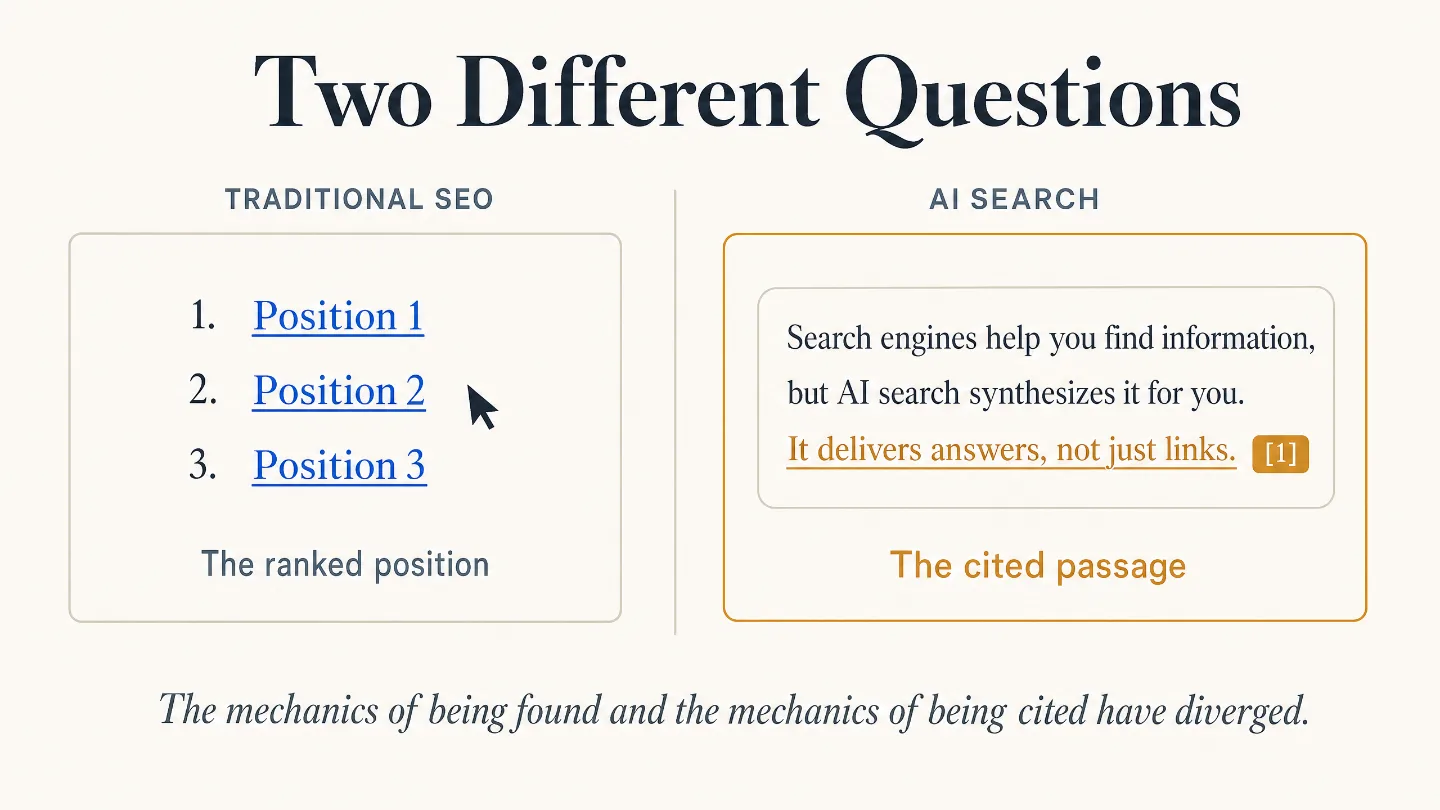
Most traditional SEO audits were designed to answer one question: can Google rank this site? It's a good question, and for two decades it was very nearly the only one that mattered. But it is no longer sufficient. A page can rank perfectly well in the ten blue links of Google or Bing and still be entirely absent from the answers ChatGPT or Claude serve up, the summary that sits above Google's results, or the recommendation Perplexity reads aloud. The mechanics of being found and the mechanics of being cited have diverged, and the audit tools most agencies rely on have not caught up. I have spent a lot of time in recent months on this, it's needing an update several times a week, but here is where I have got to in early June 2026 (I will endeavour to keep this post updated as it evolves).
This is the framework I built to close that gap. It is a 120-point rubric across six categories, and it is the same process I run on every client site before I make a single recommendation. This article sets out the whole of it: what each category measures, why it is weighted the way it is, and, just as importantly, what I deliberately refuse to score. If you run audits yourself, you are welcome to take the structure and adapt it. If you would rather I ran it on your site, there is a way to do that at the end.
A note before I begin: I will be naming sources throughout, including where they contradict one another and including where I disagree with them. That is deliberate. The single most important principle in this framework is that no vendor (not Google, not OpenAI, not anyone) gets to be the final word simply because it is their product. I will come back to that at length. To be clear, I am not the master AI engineer, but being a process and strategy-driven ADHD head, I am sharing the framework I have assembled and much of it comes from far more brilliant people than myself. I will take credit for the build and utilisation and of this and how it ends-up in clients hands, delivery of recommendations is where I see most agencies fail IMHO.
What Stephen has built here finally closes a gap I've watched the industry sidestep for years. At Digistore24 we move serious affiliate and product volume — and I can tell you from that vantage point, the shift from rank to get clicked to be cited to get trusted isn't coming, it's here. The snippet-blocking issue alone should be required reading for every performance marketing team. If your technical setup was built in the ranking era and you haven't audited it against this kind of framework, you're probably invisible in the places where high-intent buyers are making their decisions right now.

A twenty-year veteran of search and content, Nick founded the SEO agency From The Future and co-built the Traffic Think Tank community before moving in-house. As Global CMO at Digistore24 he leads marketing for a platform that powers affiliate and product sales at scale — a front-row seat to buyer behaviour shifting from ranked clicks to cited trust.
The problem: SEO frameworks don't account for AI search
Traditional SEO is built around ranking. Crawl the page, index it, position it in a results list, earn the click. Every mature audit framework, and most of the tooling, optimises for that chain. It is a sound model for a world in which the search engine returns a list and the user chooses from it.
AI search does not work that way. Google's AI Overviews, AI Mode, ChatGPT Search, Perplexity and the rest do not hand the user a list to choose from. They compose an answer, and in composing it they excerpt: they pull sentences, statistics and definitions out of pages and stitch them into a response, citing some sources and silently ignoring the rest. The unit of value is no longer the ranked position; it is the cited passage.
The unit of value is no longer the ranked position; it is the cited passage.
That shift breaks several assumptions baked into conventional audits. Ranking-era tools check whether a page is indexable, but they do not check whether it is excerptable. A page can be indexed and still carry a signal that forbids it from being quoted. They score schema on whether it is present and valid, but not on whether it tells the truth about the visible page, which is precisely the thing an AI system cross-checks. They measure crawlability against robots.txt, but they do not test whether the firewall in front of the site quietly returns a 403 to AI crawlers regardless of what robots.txt says. None of these are exotic edge cases. They are the everyday reasons a perfectly competent site is invisible to AI, and a ranking audit will not surface a single one of them.
So I needed a different instrument. Not a replacement for technical SEO (the fundamentals still hold), but a framework built around the question AI search actually asks: is this page eligible to be cited, is its content worth citing, and can it be extracted cleanly when it is?
What Stephen's framework gets right is treating citation eligibility and indexability as separate problems — because they are. A perfectly ranking page can still be completely absent from AI answers if it's blocked from being quoted, or simply has nothing specific enough to pull.

Jess is a Toronto-based technical SEO consultant who has spent over a decade auditing and untangling large, complex sites. Her work lives in the unglamorous foundations — crawlability, indexation, schema and Core Web Vitals — and increasingly in the new question of whether a page is even eligible to be cited by AI systems. She works hands-on with in-house teams to turn audits into shipped fixes.
Why I built my own rubric
I did not start from a blank page. There is good open work in this area, and I want to credit it plainly, because what I have assembled is a synthesis rather than an invention. I have curated highly reputable resources and folded them into my process, with my own layer of knowledge baked in. It's an Apple Pie - I did not invent the dish, it's my recipe, hopefully one of the better ones out there!
Three open-source skills informed the foundation. The first, goog-geo (by vishalmdi), had the most rigorous scoring rubric I had seen, a clean hundred points across five categories, but it treated Google's official AI Optimization Guide as the source of truth, and I do not. The second, ultimate-seo-geo (by mykpono), had the cleanest operating structure, a sensible Audit → Plan → Execute flow, but it tried to score everything, including emerging signals I would flag as experimental rather than gate a client's grade on. The third, seo-geo (by zebbern), had the strongest platform-data table, a genuinely useful catalogue of AI crawlers and 2026 reach figures, but read more like a reference document than a working framework.
Each captured part of the picture. None, on its own, was right for client work. So I merged the best of all three, then layered in three further sources that the open skills predated or omitted: Google's own Lighthouse Agentic Browsing category (shipped 2026), the Common Crawl Foundation's training-data access framework, and Aleyda Solis's gap-diagnosis taxonomy. The result is a 120-point rubric across six categories, with explicit, defended zones for forward-looking items kept out of the score.
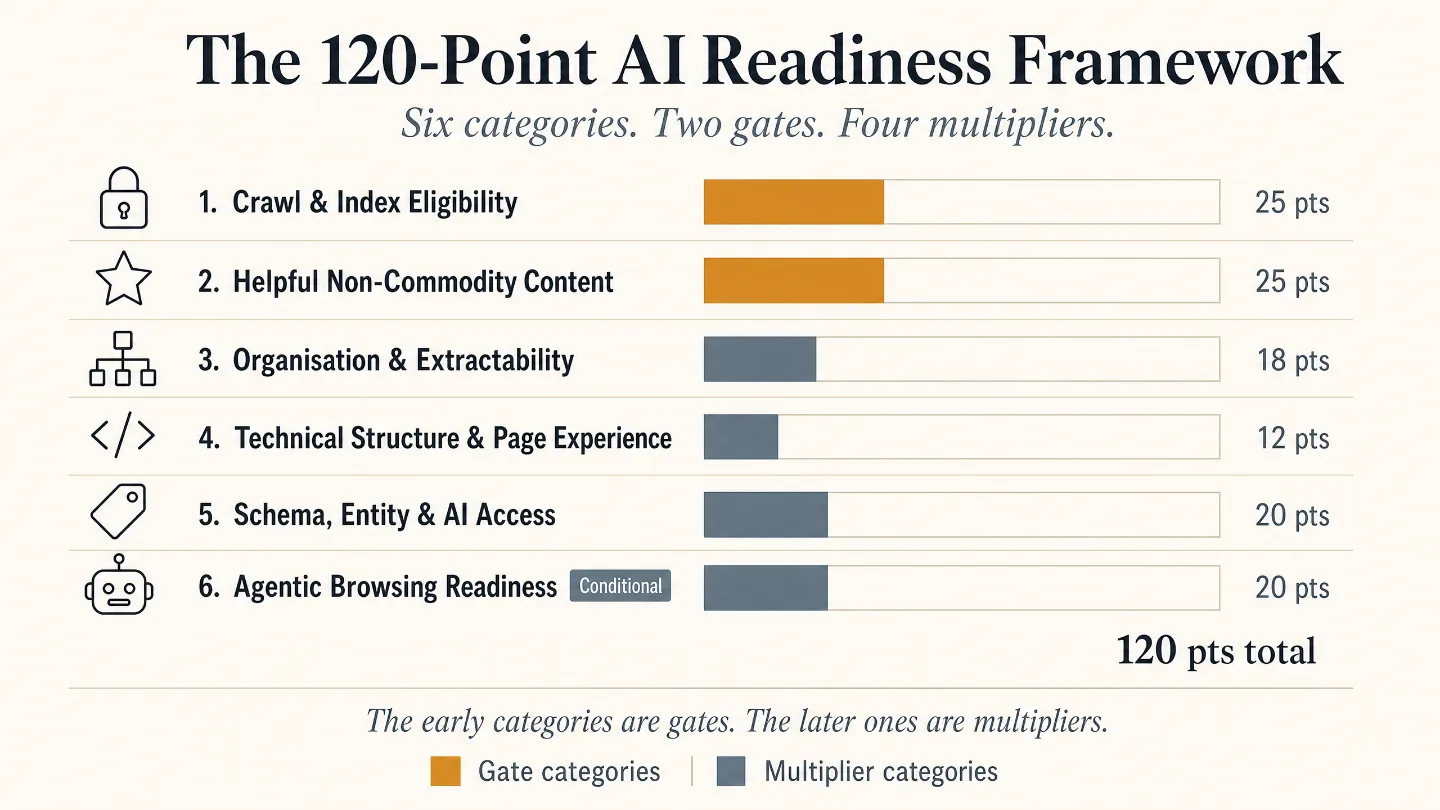
The reason it runs to 120 rather than 100 is that the sixth category, Agentic Browsing Readiness, only applies when Google's Lighthouse audit can be run against the site. When it cannot, the framework reverts cleanly to 100 points across five categories. Because the grade scale is percentage-based, the same letter grades apply either way; a site is never advantaged or penalised by whether that sixth category was in scope.
The truth-source posture
Before the categories themselves, one matter of principle, because it shapes every judgement the framework makes.
The framework does not defer to vendor positions, including Google's. Vendors have commercial bias. Their stated positions tend to favour behaviours that benefit their products, and that is true of Google, OpenAI, Perplexity and Anthropic alike when they describe their own crawlers. When sources conflict, I do three things: I surface the conflict in the client report, naming the sources and citing the data on each side; I apply calibrated practitioner judgement, weighting cross-platform evidence and field experience over any single vendor's claim, and where a genuinely new conflict arises that I have not yet formed a view on, I say so rather than pretend to certainty.
I will give the four corroborating cases for this posture later in the article. For now, simply read every category below knowing that where I take a position against a vendor's stated guidance, it is a considered position and not an oversight.
The six categories at a glance
Here is the whole rubric in one view.
Crawl & Index Eligibility
Hard gates: crawler access, indexability, snippet eligibility.
Helpful Non-Commodity Content
Whether the content is uniquely useful, not a generic summary.
Organisation & Extractability
Heading hierarchy, answer-first structure, FAQ and comparison structure, query fan-out.
Technical Structure & Page Experience
Semantic HTML, ARIA, title and description, Open Graph.
Schema, Entity & AI Access
JSON-LD types, schema-content honesty, authorship and dates, cross-platform AI bots, llms.txt.
Agentic Browsing Readiness
CLS, accessibility tree, labelled forms, WebMCP. Lighthouse-driven.
ConditionalTwo things are worth noticing immediately. First, the two heaviest categories, Crawl Eligibility and Content Quality at 25 points each, are the two that genuinely determine whether a page can be cited at all. Everything else improves the odds; these two set the ceiling. Second, the categories are ordered roughly by how binding they are. The early ones are gates: fail them and content quality is irrelevant because no one will ever read it. The later ones are multipliers: they make good content more extractable and more credible, but they cannot rescue a page that the model was never allowed to see.
Let me take each in turn.
Category 1: Crawl & Index Eligibility (25 points)
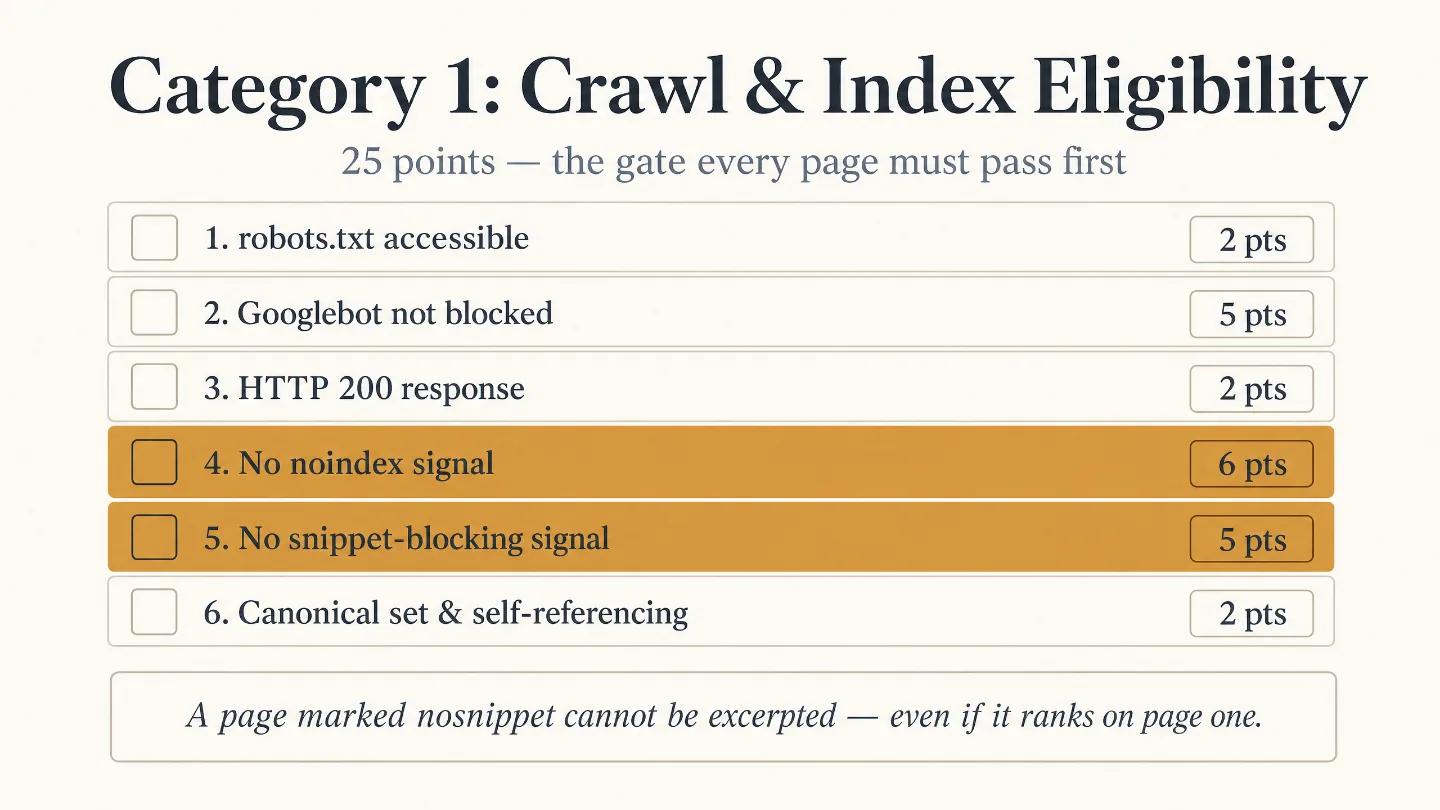
These are hard gates. A page that fails any of them cannot appear in Google's AI Overviews or AI Mode regardless of how good the content is. There is no partial credit in the real world for a page the system is forbidden from reading, and the scoring reflects that.
- robots.txt accessible2 pts
- Googlebot not blocked in robots.txt5 pts
- HTTP 200 response2 pts
- No
noindexsignal: meta tag orX-Robots-Tagheader6 pts - No snippet-blocking signal:
nosnippet,max-snippet:0, ordata-nosnippetover core content5 pts - Canonical set and self-referencing2 pts
- Informational items reported: Google-Extended status and similarnot scored
The two highest individual weights in this category, noindex at six points and the snippet-blocking signals at five, are there because they are complete-invisibility signals. It is worth understanding why nosnippet in particular is so damaging in an AI context. AI Overviews work by excerpting. A page marked nosnippet cannot be excerpted even when it is fully indexed and ranking. You have, in effect, granted permission to be listed but forbidden the one operation the AI answer depends on. I have seen this exact configuration on sites whose owners were mystified as to why they never appeared in AI summaries despite ranking on page one. The snippet directive, often applied years ago for an unrelated reason, was quietly excluding them the entire time.
The reason Google-Extended sits in the informational column rather than the scored one is covered later under the calibrated positions; in short, it governs training and grounding rather than AI Overviews eligibility, so blocking it is a legitimate business decision rather than an audit failure.
noindex or nosnippet directive removes a page from AI answers entirely, even if it ranks on page one.Category 2: Helpful Non-Commodity Content (25 points)
This is the only category scored by human judgement rather than DOM extraction, and it is the most important in the rubric. Over any meaningful time horizon, content quality is the binding constraint on AI citation. You can fix every technical gate on this list and still never be cited, because the model had nothing worth quoting.
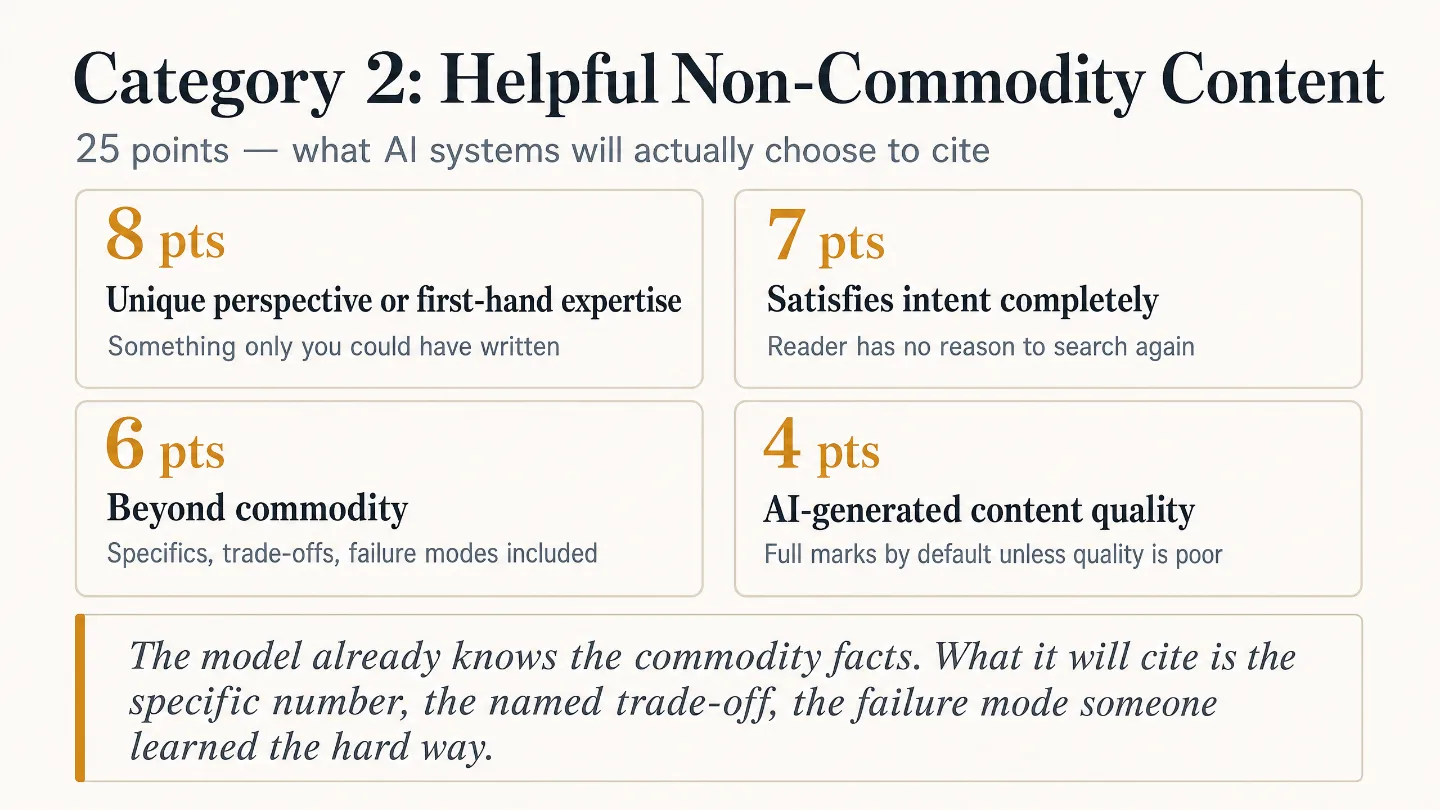
The method is deliberately simple and deliberately strict. I read the first 800 words of the page from a real browser snapshot (not a curl of the raw HTML, because so much is injected by JavaScript), and score against four questions:
- Does it show a unique perspective or first-hand expertise?8 pts
- Does it satisfy the visitor's intent without leaving them to search again?7 pts
- Does it go beyond commodity: specific details, examples, trade-offs, failure modes?6 pts
- If AI-generated content is present, is the quality acceptable? Full marks by default where there are no AI tells.4 pts
I score this category conservatively, and I would encourage anyone adapting the framework to do the same. A page that "covers the topic" without offering anything a reader could not get from a generic summary scores low, by design. Full marks are reserved for content that clearly could not be replaced by an AI's own paraphrase of the open web, because that is precisely the content an AI has a reason to cite rather than absorb and discard.
This is uncomfortable for a lot of sites, including some that perform well in conventional SEO. Thin-but-optimised content has been a viable ranking strategy for years. It is not a viable citation strategy. The model already knows the commodity facts; what it does not have, and what it will reach out to a source for, is the specific number, the named trade-off, the failure mode someone learned the hard way.
AI search is going to expose a lot of lazy content strategies. If your page is just a slightly rewritten version of what already exists online, there is very little reason for a model to cite it. The opportunity is not to game AI search, but to build pages with a real point of view, clean structure and enough evidence that they become useful inputs for the answer.

Johnny is an operator who cares about branding and design, currently working on improving patient outcomes in the medical space. He previously led marketing at Clarity, growing it from zero to roughly $1.8M ARR in two years with customers including OpenAI, Booking.com and Grubhub. He started out in finance at Razor Group, then built and sold the prompt-engineering community Promptstacks to Semrush (NYSE: SEMR).
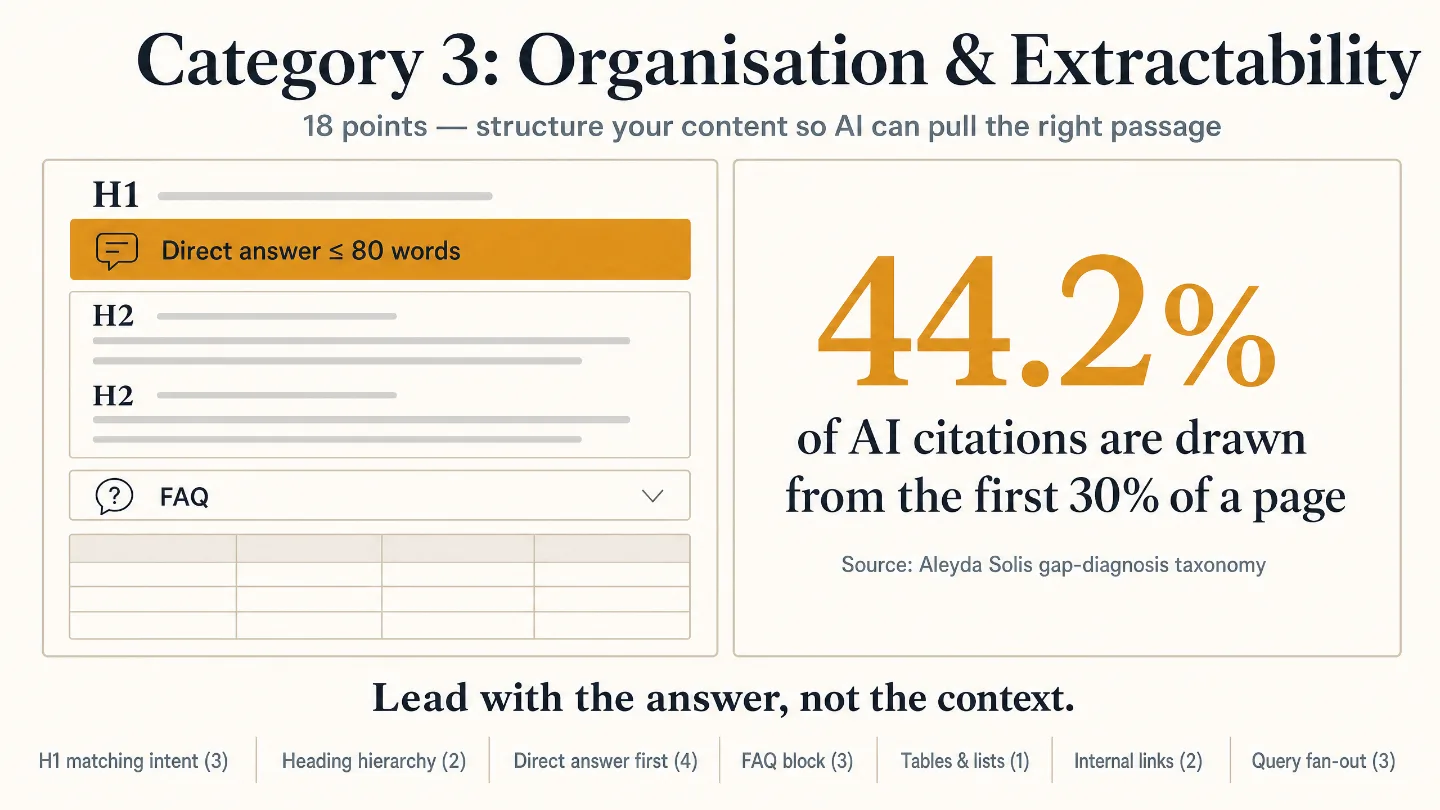
Category 3: Content Organisation & Extractability (18 points)
If Category 2 asks whether the content is worth citing, Category 3 asks whether it can be extracted cleanly when it is. Good substance buried in poor structure gets passed over for a competitor who said something less insightful but said it where the model could lift it.
- Single H1 matching query intent3 pts
- Logical heading hierarchy2 pts
- Direct answer in the first paragraph, 80 words or fewer4 pts
- FAQ or structured question-and-answer block3 pts
- Tables or ordered lists1 pt
- At least three internal links2 pts
- Query fan-out coverage: related sub-topics appearing naturally3 pts
Since June, AirOps' analysis of 12,000+ pages (a vendor selling content tooling, so vendor-sourced and weighted accordingly) has put effect sizes against this checklist: FAQ blocks carried a 40% higher citation likelihood, a clean heading hierarchy 2.8 times the citation odds, and lists or tables were present in roughly 80% of ChatGPT citations against 29% of Google's top results. Directionally, it matches what I see.
The four-point line, a direct answer in the first paragraph, carries the most weight here for a concrete, evidenced reason. Analysis of citation placement in 2025 found that 44.2% of all AI citations are drawn from the first 30% of a page's content, with 31.1% from the middle and just 24.7% from the final third. The implication is blunt: lead with the answer, not the context. The marketing throat-clearing that opens so many articles ("in today's fast-moving environment…") is not merely weak writing, it actively positions your answer outside the zone the model reads most. Top-loading is, in my experience, the single highest-leverage writing change most sites can make.
Category 4: Technical Structure & Page Experience (12 points)
This category is lighter for a reason: these are hygiene factors. They rarely make a page citable on their own, but their absence introduces friction for the systems trying to parse the page, and that friction compounds.
<main>element present2 pts<article>or semantic sectioning2 pts<title>of 50–60 characters plus a meta description3 pts- All images carry non-empty
alttext2 pts - Interactive elements have ARIA labels1 pt
- Open Graph tags present2 pts
Semantic HTML is doing quiet work here. When the primary content is wrapped in <main> and self-contained sections sit in <article>, an extraction system can identify the substance and discard the navigation, the cookie banner and the footer with far greater confidence. It is the difference between handing someone a document with the body clearly marked and handing them a page of undifferentiated text and asking them to guess which part is the point.
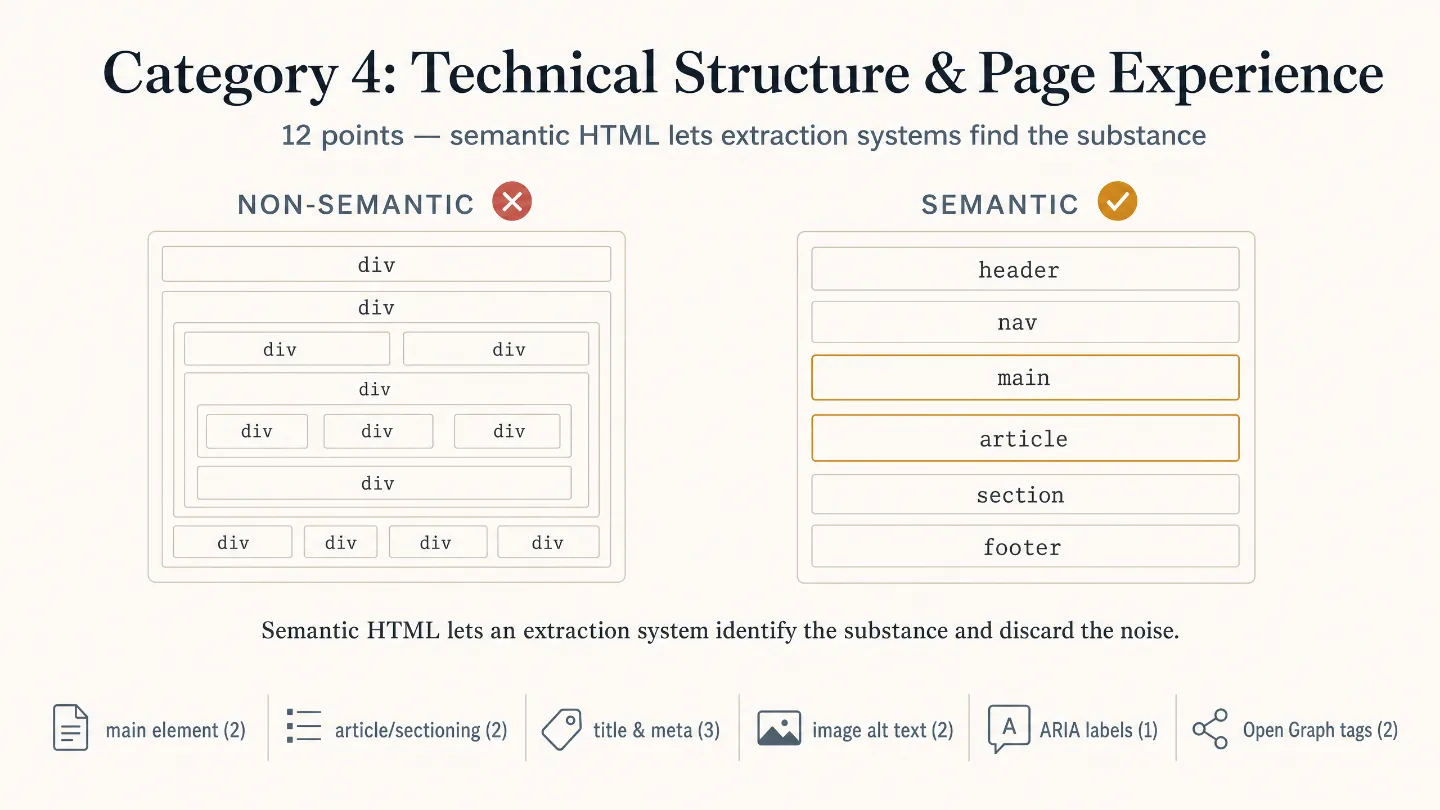
<main> and <article> lets a system identify the substance and discard the chrome. Points: main element (2), article/sectioning (2), title & meta (3), image alt text (2), ARIA labels (1), Open Graph (2).Retrieval eligibility: the 499 in your logs
In June I filed page speed under hygiene. For live AI retrieval, that undersold it, a point Mike King made in his Moz AMA and one you can verify in your own server logs.
ChatGPT and Perplexity fetch pages in real time, at answer time. A page that responds too slowly isn't ranked lower; it is skipped for that answer, because the fetcher closes the connection before your server finishes. The log signature is an HTTP 499, client closed request, against AI bot user agents (OAI-SearchBot, ChatGPT-User, PerplexityBot). Recurring 499s mean your site is being asked for answers and failing to deliver them in time, and no PageSpeed-style lab test will show it. The usual fix is edge caching at the CDN, so real-time fetchers get something within their timeout.
The same real-time fetchers also do not render JavaScript (Vercel's crawler analysis confirms most AI fetchers take raw HTML only; Google and Bing render). Anything that exists only client-side, whether product details, answers or JS-injected schema, is invisible to them. iPullRank's free Context Parity Explorer will crawl a URL as Googlebot, an AI bot and a browser, and show you the difference.
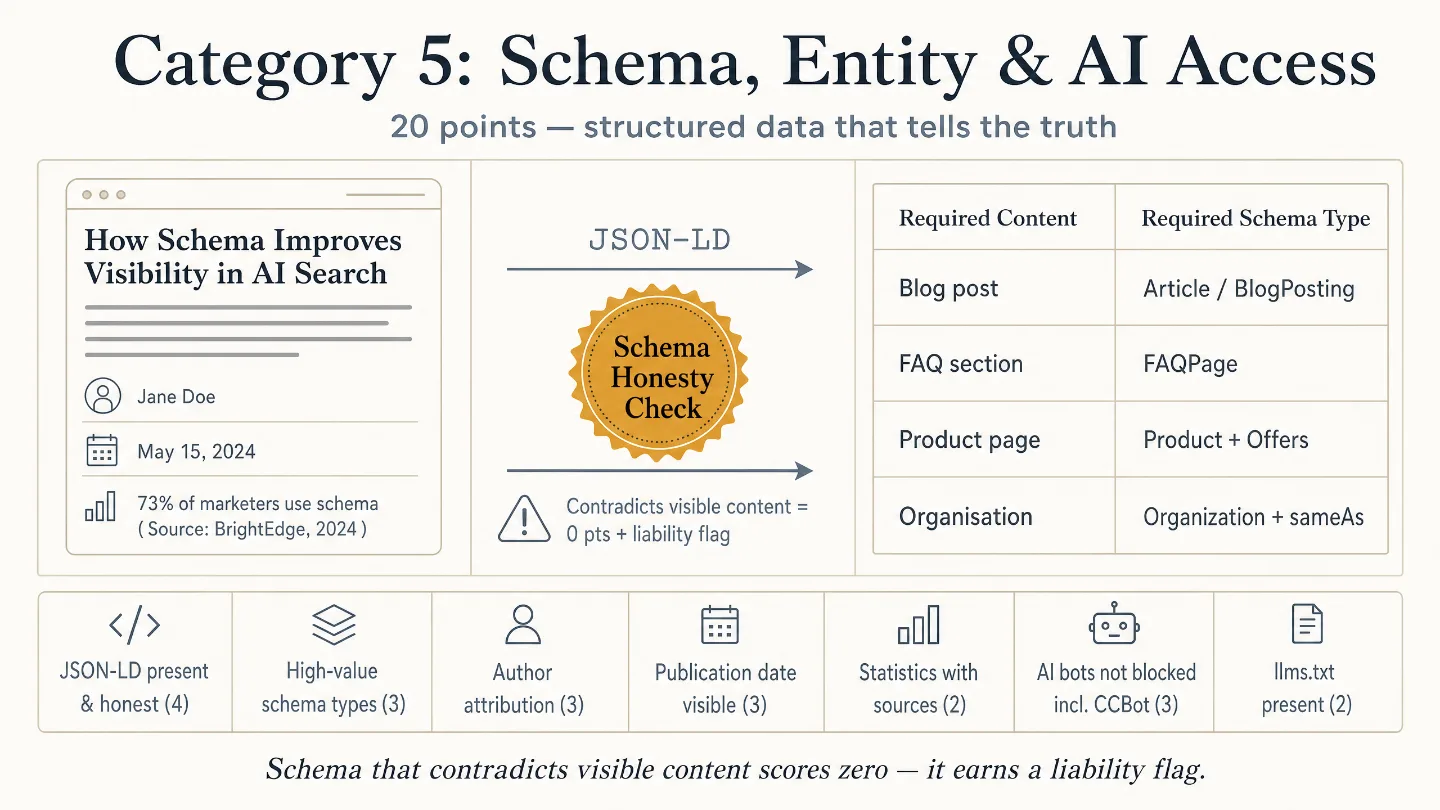
Category 5: Schema, Entity & AI Access (20 points)
This category does the most work in separating credible sites from the rest, and it carries one of my firmer positions: schema is treated here as a hard requirement, not a nice-to-have. I will defend that against Google's stated guidance shortly. The short version is that sites lacking structured data almost invariably show systemic content-discipline gaps elsewhere, regardless of what any specific platform vendor says it formally requires.
- JSON-LD present, parseable and meaningful: subject to the schema honesty principle; schema that contradicts visible content scores zero4 pts
- High-value schema types matching the page type3 pts
- Author attribution visible, with credentials3 pts
- Publication or "last updated" date visible3 pts
- Statistics with source attribution2 pts
- Cross-platform AI bots not blocked in robots.txt, including CCBot3 pts
llms.txtpresent and well-formed2 pts
Two notes on the last two lines. The llms.txt two points now require the file to be findable as well as present: the v2 proposal's link relations, a describedby header or tag pointing at the file, and at least one page with a markdown twin linked as rel="alternate" type="text/markdown". A file that exists but that no agent can discover from a page earns one point. And the crawler line is where a site's Content-Signal policy belongs, but I do not score it: the values (search, ai-input, ai-train) are the client's decision, and I check only that whatever they publish is consistent with the crawler rules above it. Setting ai-train=no on a client's behalf without asking is not an audit finding; it is an editorial act.
The schema honesty principle is worth dwelling on because it inverts how most tools score structured data. Conventional auditors reward schema for being present and valid. I reward it for being true. If Article schema declares an author of "Jane Smith" but no byline is visible anywhere on the rendered page, that schema does not earn its four points; it earns a liability flag, and I recommend removing the misleading fields. The same applies to Product schema with prices the page does not show, AggregateRating with star counts absent from the DOM, or Review schema naming reviewers invented for the markup. AI systems increasingly cross-check declared structured data against visible content at retrieval time, and a mismatch does not merely fail to help; it gets the page de-prioritised.
Schema implemented as a trick is worse than no schema at all.
For reference, the required schema types by page class are as follows:
| Page type | Required schema |
|---|---|
| Blog post / article / news | Article / BlogPosting / NewsArticle with author and dates |
| FAQ section | FAQPage |
| How-to | HowTo |
| Product | Product with offers |
| Local business | LocalBusiness |
| Organisation root | Organization with sameAs |
| Author bio | Person with credentials and sameAs |
The inclusion of CCBot in the AI-bot access check matters more than its three points suggest, and it connects to a problem most audits never test for. CCBot is Common Crawl's crawler, and the Common Crawl archive is a primary training source for most major language models. Block CCBot and you are not merely missing from one platform; you risk being absent from the training corpus that feeds nearly all of them. More on that in the discussion of the "invisible 403" below.
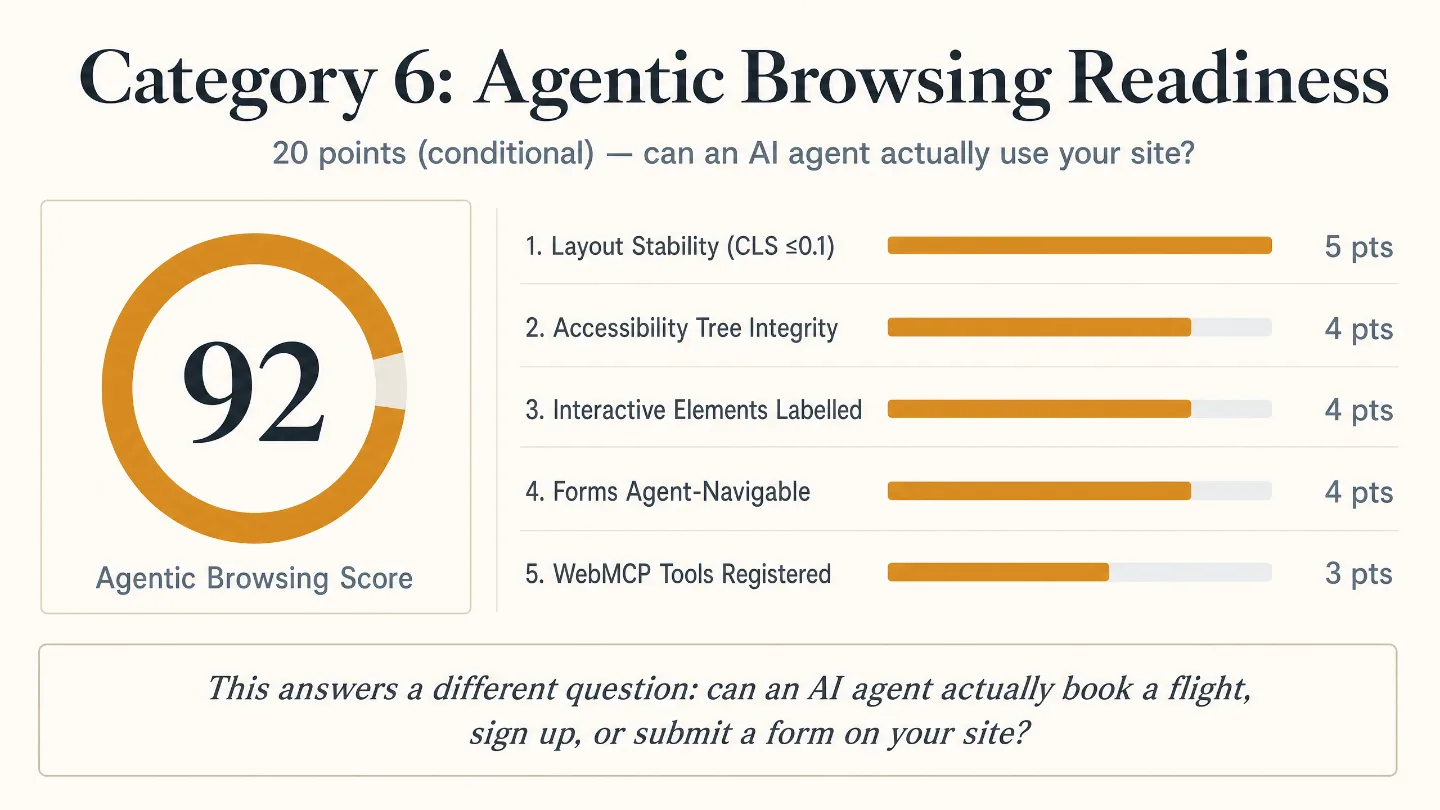
Category 6: Agentic Browsing Readiness (20 points, conditional)
This category runs only when Google's Lighthouse Agentic Browsing audit is available for the site, which in practice means sites with transactional flows worth measuring: e-commerce, booking, SaaS with forms. It measures something genuinely distinct from everything above it: not whether an AI search engine will cite the page, but whether an AI agent can navigate, label and interact with it.
- CLS within threshold: 0.1 or below is Good5 pts
- Accessibility tree integrity4 pts
- Interactive elements properly labelled: a deeper check than Category 44 pts
- Forms agent-navigable: programmatic labels, no JavaScript-only submission4 pts
- WebMCP tools registered3 pts
The distinction this category draws is the one I expect to matter most over the next few years. AI citation answers the question "will an AI mention you when answering a query?" Agentic browsing answers a different question: "can an AI agent actually book a flight on your site, sign up for your trial, or submit your contact form?" As agentic products move from demonstration to production (ChatGPT's browse mode, Claude's computer use, and the rest), the second question stops being hypothetical.
The WebMCP line has changed status since June. It is now testable: Cloudflare's isitagentready.com scanner loads the page and reports every tool registered through document.modelContext.registerTool() and every form annotated with the declarative toolname, tooldescription and toolparamdescription attributes, so "registered" is no longer a matter of reading source. The three points are awarded when the scanner, or a Chrome run with the flag on, sees tools on load and their schemas are valid. The framing of absence has not changed: no tools is reported as an emerging-specification opportunity, never as a failure, because adoption is still near zero. What has changed is the cost of doing it. On this site the whole thing is one deferred seven-kilobyte script that fetches the site's own content index and markdown twins, registers four read-only tools on every page and one consequential tool on the contact form, and does nothing at all in a browser without the API. A client with a search box or an enquiry form has the same opportunity for the same afternoon of work.
The shortlist is decided before the search
Everything above is site-level: can your pages be fetched, understood, and lifted into an answer. The most important thing I've learned since June is where the ceiling of site-level work sits.
Wire captures of ChatGPT's search behaviour (Suganthan Mohanadasan, one Plus account, sixty-plus conversations, so treat the exact numbers as directional) show that when ChatGPT is asked a "best X for Y" question, it writes brand names into its own search queries before it has retrieved a single page. In 21 of 27 test conversations, the first search already contained a shortlist of candidates the user never mentioned. The citation consequences were stark: brands named in the query were cited in 68.9% of cases; brands that merely appeared in the retrieved results, 2.1%. A roughly thirty-three-fold gap, decided before retrieval began.
A page can score 120/120 on this framework and still not win discovery prompts, because the model never searched for the brand in the first place.
Site-level work converts presence into citations; it cannot manufacture presence in the model's head. That comes from the consensus layer: the reviews, roundups, community threads and coverage this framework's Authority phase and Corroborated characteristic point at.
There is a cheap test. Open DevTools in a fresh ChatGPT session, ask your category's core buying question, and read the search fan-out for injected brand names. Repeat it a handful of times. The names that appear every run are the real competitive set, and whether yours is among them tells you whether your next quarter's work is on-page or off.
What I deliberately keep out of scoring
There is a growing set of things that sit inside my process as guidance and are deliberately not scored. I want to explain why, because the restraint is the point.
Until September there were three: Site-as-MCP, EntityMap and Common Crawl edge-access testing. The list has moved. Site-as-MCP has graduated from hypothesis to something I can build and test in a day: a read-only MCP server over a site's existing content is a single Cloudflare Worker with no database, and the scanner in the next section can see it. WebMCP made the same move. Neither is scored, for the reason below, but neither is speculative any more. In their place the forward-looking list now holds DNS-AID with DNSSEC (DNS records that advertise an agent endpoint, which only make sense once there is one), Web Bot Auth on the publishing side (for sites that operate their own crawler), an A2A agent card (for sites that run an A2A agent), and the agent-commerce protocols (x402, MPP, UCP, ACP, AP2) for stores that have made a payments decision. EntityMap and the Common Crawl edge test are unchanged.
Each of these is treated the same way: trigger criteria for when to recommend it, an explicit statement of what it solves and what it does not, the auditor checks to verify presence or absence, paste-in recommendation language, and an honesty flag on experimental status.
Things with no confirmed consumer do not go in the score, even when they are plausible and even when I recommend them. Neither Site-as-MCP nor EntityMap has a single confirmed AI-platform consumer today, even where a scanner can now detect them. Both are plausibly valuable. Both are cheap to implement. I do recommend them to the right clients as first-mover bets. But to fold them into a client's grade would be to penalise every site that has not adopted an unproven standard, and that is neither fair nor honest.
This restraint cuts against the grain of a lot of AI-search commentary, which tends either to ignore emerging standards entirely or to pitch them as the new must-have. The honest middle ground (recommend cautiously, label the experimental status plainly, and watch the server logs) is the one I have found lands best with the kind of client who has been burned before by consultants selling hype.
The seventh step I don't score: the agent discovery ladder
The 120 points answer one question: will an AI system cite this page? Since September the audit ends with a second, unscored step that answers a different one: can an agent find, read and act on this site without a human in the loop?
That is a newer layer than citation, and it has its own test. Cloudflare's scanner at isitagentready.com runs about twenty checks across five groups and places a site on a five-level ladder from bare discoverability to "Agent-Native". I use its model rather than invent my own because the checks map onto published specifications rather than opinions, and because a client can re-run it themselves in thirty seconds and see the same result I report. The groups are:
- 01Discoverability: robots.txt and sitemap, the
Linkrelations on responses (describedbyfor llms.txt,alternatefor markdown,api-catalog,ard), and DNS-AID records. - 02Content accessibility: whether a request with
Accept: text/markdowngets markdown back, with the HTML still the default for browsers. - 03Bot access control: explicit rules for the named AI crawlers, a
Content-Signalline, and Web Bot Auth. - 04Discovery documents: an RFC 9727 API catalog, an MCP Server Card, an agent-skills index, an ARD capability manifest, WebMCP tools on page load, an A2A agent card, and the OAuth discovery trio.
- 05Commerce: the agent-payment protocols, reported only when the site sells something.
I report the ladder next to the score, not inside it, and I run every check under three rules.
Fix what is real and cheap. Link relations, markdown twins with content negotiation, a Content-Signal line, an API catalog, a security.txt: each is a few lines of edge configuration or a build step, and each makes the site more legible to the next agent that arrives. There is no argument for leaving them out.
Decline anything that would be an empty claim, and say why. This is the part most tools get wrong. The scanner reports a missing OAuth discovery document as a failure. For a site with no protected API, publishing one would send agents to a login that does not exist, so the honest finding is "not applicable, and here is the day it becomes applicable". The same goes for Web Bot Auth on a site that runs no crawler, for DNS records that advertise an agent endpoint the site does not have, and for the auth.md registration file that only means something on top of the other two. Level 5 on Cloudflare's ladder requires that authentication stack, which is why I tell content-site clients that Level 4 is their honest ceiling and they should not chase the last rung.
Name the gate. Some checks are not failures but dependencies. An MCP server, once it exists, unlocks the server card, the ARD entry, the DNS record and the catalog entry in one move. Reporting "four fails" when the real finding is "one endpoint" misleads the client about the size of the job.
I ran this on my own site first, which is how the rules got written. On 29 September it went from nothing on the ladder to Level 4 in a day: a read-only MCP server over the site's markdown, a server card and capability manifest, four of the frameworks from this blog published as loadable agent skills with content digests, WebMCP tools on every page, and the catalog and link relations tying them together. Three checks were declined on the grounds above and stay declined. Two findings I did not expect are worth passing on. Cloudflare's own edge, with Browser Integrity Check on, returns 403 to Python's default user agent and to nothing else I tested, which silently breaks a class of agents and the scanner's own reference tooling; it is a one-toggle fix and it is now in every audit I run. And the specifications are moving faster than the scanners: the MCP Server Card and the ARD manifest both changed their canonical location this quarter, so the honest implementation serves the current path and the one the scanners still probe, and says which is which.
None of this is a ranking factor, and I do not present it as one. The measurable effect of agent addressability on traffic today is close to zero, the same honest position I hold on llms.txt. The reason to do it is the reason to publish a sitemap in 2006: it costs a day, it is verifiable, and it is the floor the next layer of demand will assume is there.
The four cases for not deferring to vendors
I promised earlier to defend the truth-source posture, because it is the spine of the whole framework. Here are the four cases that, taken together, convince me that practitioner judgement must sit above vendor deference.
Case one: Google contradicts itself on llms.txt
Google's AI Optimization Guide states plainly that llms.txt has "no effect on AI Search." Google's own Lighthouse Agentic Browsing category, shipped roughly eighteen months later, audits the presence of llms.txt as a positive discoverability signal. Same vendor, opposite positions, in two of their own documents. This is the single cleanest piece of evidence I have for the argument: if even Google's documentation cannot agree with itself, no single vendor statement can be treated as settled fact.
Case two: Common Crawl's edge-block research shows robots.txt is incomplete
The Common Crawl Foundation's field guide documents what every honest practitioner eventually discovers: that a large share of top properties block AI bots at the CDN or WAF layer even when robots.txt is entirely clean. Vendors describe robots.txt as the access mechanism. The empirical reality is that the edge layer silently overrides it. Common Crawl is the most credible source on this precisely because they run the bot that gets blocked.
Case three: Aleyda Solis's anti-overclaim discipline
Her Impact Layer framework explicitly rejects blending observed AI traffic with modelled and proxy signals into one tidy "AI visibility" number, which is exactly what most vendor visibility tools do. The honest discipline is not "trust the score"; it is "separate the layers, label confidence, document assumptions."
Case four: Princeton's GEO research
The academic work behind the citability mechanics (self-contained answer blocks, top-loaded answers, named statistics with sources) is independent of any vendor's commercial position. I use it as the academic anchor for the rubric's content-extraction checks precisely because it has no product to sell.
Notice that three of these four cases are not about Google at all. The argument is not anti-Google; it is anti-deference. When all four sources align on a position, that position is durable and I treat it as such. When they diverge, I surface the conflict transparently rather than pick a side and present it to a client as fact. I never quote a vendor's claim as settled in a deliverable; I attribute it ("Google states X…") and present the framework's stance alongside.
llms.txt is also an attack surface
I still score llms.txt positively, for the same reasons as in June: near-zero cost, growing adoption, and Google's own Lighthouse audits check for it even while Google's guidance says it does nothing. (The specification itself was revised in August; I've written up what changed in v2 separately.) But my recommendation now carries a condition I would not have thought to include three months ago, and it comes from security research rather than SEO.
In August, researcher Alon Hertz published the results of reading llms.txt files at scale: 8,565 files across 6,214 live domains. Inside them he found more than 237 referenced artefacts that didn't exist: package names printed in official install instructions that nobody had ever registered on PyPI or npm, expired domains, abandoned cloud subdomains. His team registered a handful of those exact package names with a harmless beacon inside. The first callback from inside a Fortune 500 company arrived in under four minutes: an AI coding agent had read the company's own llms.txt, seen the install command, and run it. The package came from the public registry exactly as the file said. It just wasn't the company's package.
This wasn't hypothetical elsewhere, either. A third party had already registered the unclaimed name in one authentication vendor's agent-facing docs and shipped genuinely malicious code at it, catalogued as MAL-2026-11069. The vendor responded quickly; the structural problem is everyone's.
AI agents execute what agent-facing files say. A file written for machines to act on has the trust obligations of code, not of content. So: recommend llms.txt, and when one exists, or when I generate one, every referenced package must resolve to the vendor's own registry account, every domain must be registered and controlled, and bare npx commands must name a package that actually exists standalone. An unclaimed reference is a critical finding, because anyone can claim it. A stale, unverified llms.txt is worse than no llms.txt at all.
How I use it: Audit, Plan, Execute
A rubric is only as good as the process it sits inside. Mine runs in three modes.
Audit produces the scored report: every check evidenced, a gap diagnosis, and a citation demonstration: a genuine before-and-after rewrite of one of the client's own passages, so they can see what extractable content looks like rather than take my word for it. Since September the audit closes with the agent discovery ladder from the previous section, reported as a level next to the score and never blended into it.
Plan turns findings into a four-phase roadmap: Foundation, Expansion, Scale, Authority. But the roadmap opens with a step that I think matters more than the phasing: gap diagnosis. Every finding is tagged against one of ten characteristics drawn from Aleyda Solis's framework: Accessible, Extractable, Useful, Fresh, Differentiated, Credible, Recognisable, Consistent, Corroborated, Transactable. The phasing tells the client when the work happens. The gap diagnosis tells them what kind of work this really is. A typical report reads less like a flat list and more like this: "Of your eighteen findings, six are Accessibility problems (fix the technical crawl layer); eight are Extractability problems (restructure and rewrite pages for AI extraction); three are Credibility problems (add authorship, sourcing and dates); one is Transactability (a Lighthouse-flagged form-labelling issue). The Accessibility group is the highest-leverage and the fastest, so we lead there." That framing names what the client is actually buying: sometimes a technical engagement, sometimes a content engagement, sometimes a brand engagement.
A correction from the June version of this piece: I originally listed nine characteristics, noting that Aleyda's checklist enumerated nine of its promised ten. Her 3-Layer Diagnostic & Measurement Matrix, published since, enumerates all ten. The one I was missing is Fresh: are the dates, facts, pricing and availability current enough to remain credible and citable, with a visible last-updated date and a defined update cadence? It turns out Fresh is not a minor addition. The next section explains why it may be the most time-sensitive characteristic of the ten.
Execute ships the fixes. Safe, self-contained changes (meta tags, alt text, content, JSON-LD, Open Graph, llms.txt) go in directly. Higher-impact changes (robots.txt, canonicals, redirect maps, noindex removal, hreflang, CMS template changes) are described in plain language and confirmed before any code is written, because those are the changes that can do real damage if a misunderstanding has crept in.
Findings can be pushed to a client's Trello board as cards, one card per finding rather than per page, labelled by severity, time-to-fix, effort and category. One deliberate omission: I never use "Risk" as a label. "Critical Issue, Low Risk" reads as a contradiction to a client, conflating the severity of a problem with the safety of its fix. The same information is carried by Severity, Time to Fix and Effort, without the muddle.
The monthly window: freshness is a retrieval parameter
In June, freshness in this framework was a three-point checklist item: is a last-updated date visible? Three independent lines of evidence published since then have convinced me it deserves its own section, because freshness is not a quality signal being weighed. It is a parameter in the retrieval request itself.
In August, ChatGPT's search tool was rebuilt around a compact query language, captured in wire-level detail by Suganthan Mohanadasan (one account, DevTools network traffic; directional, but the mechanism is reproducible by anyone). Each search line carries an explicit freshness window in days, calibrated to query type: around two days for stock prices, seven for sports, roughly thirty days for commercial and product queries, and up to ten years for Reddit archaeology. A pricing or comparison page that hasn't been touched in eight months isn't being judged harshly. It may sit outside the default window the retrieval system asks for.
AirOps' analysis of 12,000+ pages (a vendor selling content-refresh tooling, so weight accordingly) puts numbers on the same shape from the citation side: 70% of AI-cited pages were updated within the past year, content under three months old was three times more likely to be cited, and pages going more than three months without an update were three times more likely to lose visibility.
And when Moz's Dr Pete Meyers extracted 5,333 real Gemini grounding queries via the Vertex API, a third of them explicitly contained a year, often two in sequence ("2025 2026"). The machine is not inferring freshness from your page; it is asking for it in the query.
Three sources, three methodologies, one conclusion: for commercial pages, plan a monthly-to-quarterly refresh cadence with the date visibly updated, and treat "when was this last touched?" as a first-class audit question, which is exactly what the Fresh characteristic now does. This article carries a dated changelog for the same reason.
Where AI influence actually shows up in your analytics
The anti-overclaim discipline from June stands: observed, proxy and modelled signals stay separate. What's new is a clearer picture of where to look, because the single most common measurement error I now see is judging AI search by the referral line from chatgpt.com.
LLM influence rarely arrives as LLM referral traffic. People read an answer, then search the brand or type the domain, and the visit lands in Direct and branded organic. Profound reports one company with under 1% LLM referral traffic whose customer survey showed 13.7% of new customers naming an LLM as first touch: vendor-sourced, but directionally consistent with everything else in this section.
There is a free, plottable signature for it. Siege Media's fifty-site study found that as traffic shifted to LLMs and AI Overviews, homepage clicks rose 10.7% and homepage impressions 54.7% while whole-site clicks fell, because AI answers return names, not links, and people follow up on the name. Rising homepage demand in Search Console against falling site-wide click-through is AI-influenced brand discovery you can show without buying any tracking platform. The cheapest instrument of all remains a "How did you hear about us?" field on your forms, added before the work ships, so there's a baseline.
On timing: Profound's data (surfaced via LinkedIn's marketing blog, so a vendor chain, labelled as such) puts the median time for a new page's first AI citation at about seven days, with 90% of pages that will ever be cited reaching it within about 37. So the re-check window I use is four to eight weeks, and zero citation movement at five weeks is a signal to re-diagnose, not to wait. Community work runs on a different clock entirely: a Reddit or forum contribution has to accumulate age and engagement before models pick it up on refresh. Measure it at thirty days, expect nothing at thirty, judge at ninety.
A word on honest expectations
I will close the substance with the thing I am most careful to say to every client, because it is the thing the market most often gets wrong.
AI search is not replacing SEO. Across the same datasets that produce the citation figures above, organic search remains roughly 108 times larger than AI in measured visits. AI is influential, particularly in the discovery and evaluation moments where someone is weighing options rather than navigating to a brand they already know, but the raw click volume is not there yet, and anyone telling you "AI is the new SEO" is selling you something. The honest framing is narrower and more useful: AI is the discovery layer for high-intent decisions, it is growing very quickly, and on that layer being cited matters more than being clicked. That is worth getting ahead of. It is not worth abandoning everything that still drives the other 99% of your traffic. The same is true of agent readiness: worth a day, not worth a budget line, until an agent actually shows up in the logs.
That same discipline runs through how I report. I do not blend observed traffic, proxy signals and modelled estimates into a single "AI visibility score", because each of those means something different and blending them is overclaim. I report what I can observe as observed, label what is modelled as modelled, and never tell a client "AI search drove £X" when X was inferred from proxies. If that makes my reports look less impressive than a competitor's single confident number, so be it. The number that is honest is the one worth having.

I'll tell you honestly where you stand, including the parts a conventional audit would never find.
The full scored audit, the gap diagnosis, a before-and-after rewrite of your own content, and a phased plan to close the gaps. A page must be eligible to be cited before content quality matters at all. Once it is eligible, the content has to be worth quoting and structured so it can be lifted cleanly. That's exactly what Local SEO Ltd does.
Request an audit